

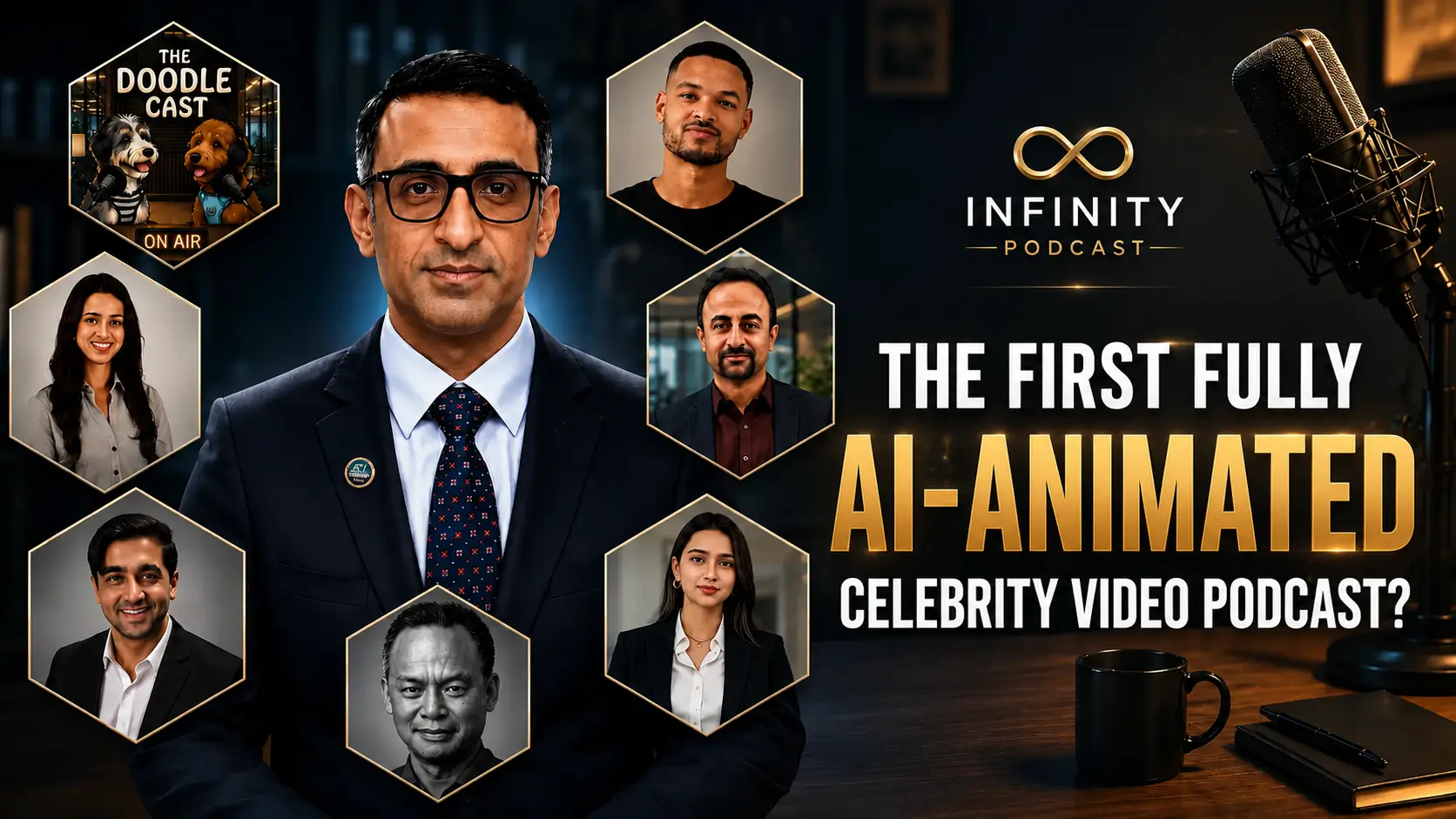
AI is changing almost every part of digital media. We have AI-generated images, videos, music, voices, presenters and even complete films. So, naturally, the next big question is: can AI create a complete podcast too?
Recently, I started looking into this question because of Infinity Podcast, an AI-based project started at Infinity Technest a digital marketing agency. The more I researched, the more interesting the story became. My main question was simple: has anyone already created a fully AI-based animated video podcast? And if yes, where does Infinity Podcast stand in this history?
The answer is not as simple as saying “world’s first AI podcast.” There were several interesting experiments before Infinity Podcast, but almost every one of them was different in one important way.
It Started in Pakistan in 2023
One of the earliest examples I found was from Pakistan. In July 2023, Discover Pakistan uploaded a video called AI Talk, which they promoted as the world’s first AI TV Talk Show. The anchor and guests were presented through AI, and it was definitely a very early and impressive use of AI characters in a conversation-based video format.
But there is an important difference. Discover Pakistan itself called it an AI TV Talk Show, not a podcast. It was essentially an AI experiment in television broadcasting.
You can watch the original Discover Pakistan AI Talk here.
So, in my opinion, Discover Pakistan deserves credit for pioneering an AI TV Talk Show, but I would not classify it as the first fully AI video podcast.
Then Came Qaisar Roonjha’s Urdu AI Experiment
In August 2023, Pakistani creator Qaisar Roonjha uploaded videos under the title Urdu AI Podcast. This is another important project that appears very early in the timeline. However, when we look at the actual format, it is quite different, because Qaisar was primarily creating educational content around AI and demonstrating how people could interact with artificial intelligence.
In the podcast-style video, Qaisar asks questions and an AI application responds. So yes, there is a conversational or podcast element, but it isn’t an animated podcast with AI versions of a host and guest.
You can watch Qaisar Roonjha’s Urdu AI Podcast here.
It was certainly an early Urdu AI conversation experiment, but it belongs to a different category from what we now call an AI-animated video podcast.
Lina Colucci Came Much Closer in 2024
Then I found something much more interesting. In 2024, AI entrepreneur Lina Colucci created what she described as a fully AI-generated podcast using AI hosts. This project comes very close to the definition I was looking for. She used Google’s NotebookLM to generate the conversation and Midjourney to create images of two podcast hosts, then animated those images with AI to create the visual podcast.
You can see Lina Colucci’s original AI podcast experiment here.
In my research, this is probably one of the earliest genuine examples of an AI-generated video podcast featuring AI characters.
But there is one major difference. As far as I could find, this was an experiment or individual production, not an ongoing podcast series with recurring episodes, a permanent host and different guests. So I would give Lina significant credit for being one of the earliest creators to demonstrate what a fully AI-generated video podcast could look like.
Edward Wong and AI-FYI in April 2025
The next important project appeared in April 2025 when Edward Wong created AI-FYI. This project was impressive because AI wasn’t only generating the voice, the system could research news, select stories, write scripts and create a conversation between two virtual hosts. The two hosts even had different personalities: Albert was more analytical and cautious, while Lucinda was designed to be more curious and experimental.
You can read Edward Wong’s explanation of AI-FYI here.
But when I looked deeper, I found an important detail: Edward explains that the final podcast video used a static branded image with the generated audio. He even mentioned animated avatars as something that could be added in the future.
So, for me, AI-FYI is a proper AI-generated audio podcast that’s the first step towards AI generated video podcasts.
Then Steven Bartlett Entered the AI Game
In 2025, things became even more interesting when famous podcaster Steven Bartlett entered the AI space with “100 CEOs with Steven Bartlett”. This project used an AI version of Steven, his voice was cloned and an animated representation of him was used to create content without Steven having to physically record every performance.
You can read about Steven Bartlett’s AI project in Business Insider.
This was a major step because now we weren’t talking about a random fictional AI character, a real and famous human personality was being recreated through AI.
But again, the format matters. 100 CEOs is primarily a narrated storytelling/video series rather than the traditional host-and-guest podcast conversation. Still, I think Steven Bartlett deserves credit for taking the AI clone of a real media personality into mainstream content production.
The Doodle Cast Arrived in December 2025
During my research, I also found The Doodle Cast, which started publishing its AI-animated content in December 2025. The show features Rusty and Oreo, two dogs transformed into recurring animated characters. They sit, talk and discuss different topics using AI-generated production, and the creators themselves describe the project as an AI-animated podcast, so it deserves to be included in this history.
You can explore The Doodle Cast project here.
The biggest difference is the concept. The Doodle Cast is an entertainment series built around talking pets, while Infinity Podcast recreates a traditional human celebrity interview environment. So The Doodle Cast is definitely an early AI-animated podcast, but it is a very different category of podcast.
Nematullah Baloch Also Experimented With AI Podcasts in Pakistan
I also found the work of Pakistani creator Nematullah Baloch, who has described his project as Pakistan’s first AI-made podcast. He has created AI-generated podcast content on subjects like governance, education, energy, climate change and sustainable development, and some of this content has also been produced in Urdu.
You can see Nematullah Baloch’s AI work here.
In one of these formats, an AI-generated host interviews an AI representation/clone of a real person, which takes us even closer to the format we are discussing.
For this reason, I don’t think Infinity Podcast should claim to be simply Pakistan’s first AI podcast. That claim would be too broad.
And Then Comes Infinity Podcast
Now we come to the Infinity Podcast, started at Infinity Technest in 2026. The host of Infinity Podcast is Soma Waqar, COO of Infinity Technest. But instead of Soma appearing physically in front of the camera, her real identity is recreated as an animated AI character.
You can see the Soma Waqar Infinity Podcast here.
This is where the concept becomes different. Soma remains the recurring host, but her face and personality are transformed into an animated version, while AI technology is used to clone the voice and visual performance. Then we do the same thing with the guests.
Real Celebrities Become Animated Podcast Guests
Infinity Podcast does not use random fictional characters as its celebrity guests. The characters are based on real-life Pakistani celebrities and well-known personalities. Their faces are transformed into cinematic cartoon-style animated characters, their voices are recreated using AI voice-cloning technology, and their visual performance is generated through AI animation.
So when you watch an episode, you are watching something that looks like a traditional celebrity podcast, but the entire visual world is animated through AI. The host is animated, the guest is animated, the studio is virtual, the voices are AI-generated or cloned, and the visual performances are created through AI.
The Biggest Difference: It Is a Series
This is one of the most important points for me. We have already seen one-off AI podcast experiments, AI-generated audio podcasts, animated pets, and AI versions of famous personalities. But Infinity Podcast is being developed as an ongoing Urdu celebrity podcast series.
Soma Waqar remains the recurring host, while different Pakistani personalities appear as animated AI guests in different episodes. That makes it much closer to the structure of a traditional celebrity podcast, except that the entire visual presentation exists inside an AI-generated animated world.
So Can We Call It the World’s First AI Podcast?
No. I don’t think we should. There were AI podcasts and AI podcast experiments before Infinity Podcast, and the creators behind those projects deserve proper credit. But “AI Podcast” is simply too broad a term.
The more interesting question is whether there was already a recurring, fully AI-animated Urdu celebrity podcast series featuring AI clones of real-life human personalities. Based on all the publicly available projects I could find during this research, I couldn’t find an earlier project matching this complete format.
The Claim I Believe Infinity Podcast Can Make
After going through this entire timeline, I believe the most accurate positioning is: Infinity Podcast, “The First Fully AI-Animated Urdu Celebrity Podcast Series”. That is very different from saying it is the world’s first AI podcast.
We are defining a specific category: Urdu, recurring podcast series, real human host, celebrity guests, AI clones, cloned voices, animated characters, and a virtual podcast environment. Based on the publicly discoverable material I researched, I haven’t found an earlier podcast series that combines all of these elements.
Why Is This More Than Just an AI Experiment?
For me, the interesting part isn’t simply that AI can make a cartoon character talk, we have already reached that stage. The bigger idea is that real personalities can now have animated digital versions of themselves capable of existing inside a completely virtual media environment.
A podcast studio does not necessarily have to be a physical room anymore. The host doesn’t necessarily have to sit in front of three cameras, and visually, the guest doesn’t necessarily have to be sitting across the table. AI is beginning to separate content creation from physical production.
Imagine Where This Could Go
Imagine a host in Pakistan interviewing someone living in the United States, UK or Dubai. Instead of making them travel to the same studio, their approved digital versions could appear together inside a virtual podcast environment. The voices could be recreated, the visual performance could be animated, camera angles could be generated and even the studio could exist only digitally.
This does not mean traditional podcasts will disappear. But it creates an entirely new format alongside them.
I Call It an AI-Native Animated Podcast
I think we now need better terminology because the term “AI Podcast” has become too broad. When AI only edits a podcast, it is considered AI-assisted podcasting. An AI-voiced podcast, on the other hand, uses AI to generate the voices. If a static image is placed over an AI conversation, it is essentially an AI-generated audio podcast distributed as video.
But when the host, guest, voices, animation, visual performance and studio environment all exist through AI, we have something different. I would call this: AI-Native Animated Video Podcasting. And Infinity Podcast takes this concept one step further by applying it to an Urdu celebrity interview format.
Why Does Urdu Make This Even More Interesting?
Most major experiments with generative AI are first developed for English-speaking audiences. Pakistan has more than 240 million people, and Urdu reaches an enormous audience both inside and outside the country. Earlier creators helped explain AI in Urdu.
Infinity Podcast is trying something different. Instead of talking about AI in Urdu, we are using AI itself to create Urdu entertainment. That is the shift I find most exciting.
Final Thoughts
When I started this research, I wanted to know whether Infinity Podcast could be called the world’s first AI podcast. After going through the history, I realized that would be the wrong claim, because there were several important creators before us, and each one contributed something to the evolution of this format.
Discover Pakistan experimented with AI television. Qaisar Roonjha explored AI conversations in Urdu. Lina Colucci demonstrated AI-generated video podcast hosts. Edward Wong created an automated AI audio podcast. Steven Bartlett experimented with cloning a famous real-world personality. The Doodle Cast created recurring animated podcast characters, while Nematullah Baloch experimented with AI-generated Urdu podcasts in Pakistan.
Infinity Podcast takes elements from this technological evolution and brings them together in another format: a recurring Urdu celebrity podcast where the host and guests are animated AI versions of real people. That is why, based on the publicly discoverable projects I reviewed, I believe the most appropriate description is: Infinity Podcast, “The First Fully AI-Animated Urdu Celebrity Podcast Series”.
It is not the world’s first use of AI in podcasting. It is a new way of imagining what an Urdu celebrity podcast can become in the age of artificial intelligence.
Research & Analysis by Muhammad Abid Ayub
Research Note: This analysis is based on publicly discoverable and indexed material reviewed in August 2026 by Muhammad Abid Ayub. The AI media industry is developing rapidly, and private, deleted or poorly indexed experiments may exist that were not discoverable during this research.